Staigex: A Six-Crossing Decorative Knot
Last updated
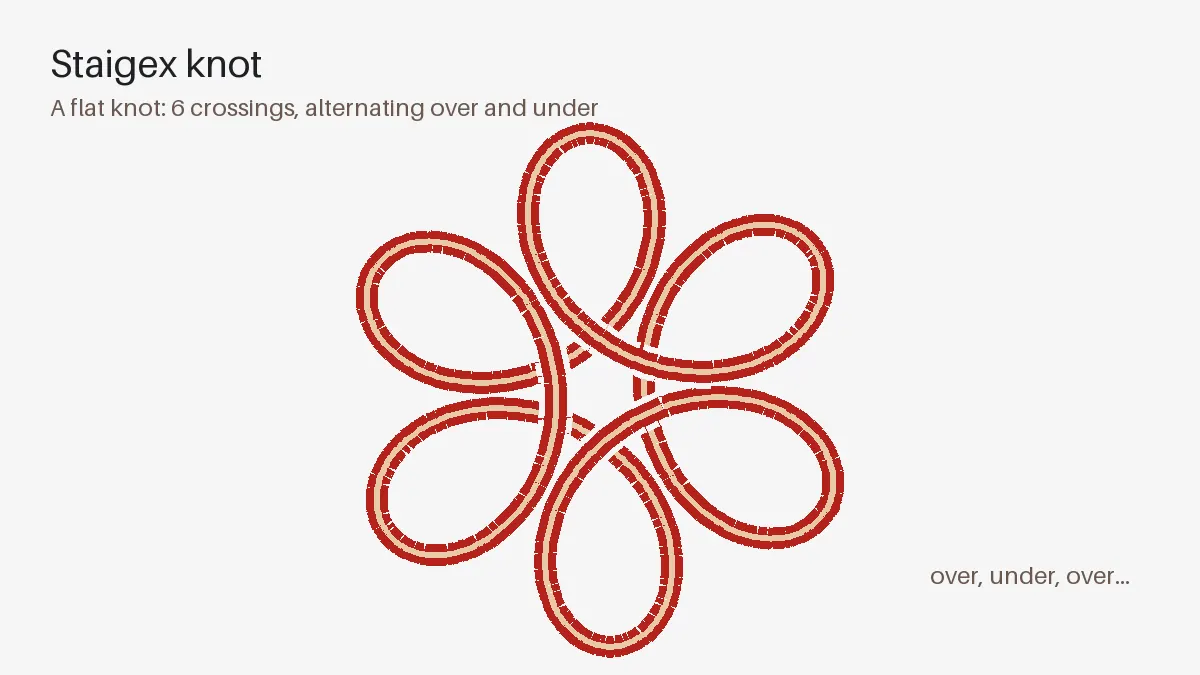
Staigex is a coined name a few cord crafters use for a flat decorative knot built from six crossings in a single length of cord. When it is pulled snug, the knot settles into a rough six-sided shape with an open center. The word was made up for convenience, and there is no claim that the knot comes from any particular tradition.
What makes the staigex appealing is that it lies flat. Many decorative knots bulge into a ball, but this one stays thin, so it sits comfortably on a keychain or the end of a zipper without catching on everything nearby.
Tying the Basic Form
Begin a staigex by laying a loop of cord on the table with the working end on the right. Bring the working end over the standing part to form a second loop, then weave it under, over, and under through the first loop so the two loops overlap like links. Continue around the shape, alternating over and under at every crossing, until you have passed through six crossings and the working end exits beside the standing part.
At this stage the knot will look loose and floppy. That is normal. The shape only appears after careful tightening.
Checking Your Crossings
Before tightening, trace the path with a finger and say over or under out loud at each crossing. If two overs or two unders appear in a row, the knot will collapse into a tangle instead of forming its hexagon. Fixing it now is easy: pull the working end back to the error and rethread from there.
Also check that the loops are roughly the same size. One oversized loop will become one long side in the finished staigex, and evening it out after tightening takes far more work than adjusting it while everything is still loose.
Cord Choices and Sizes
The material you choose affects how crisp the finished knot looks.
- Paracord gives a bold, chunky result that is easy to handle.
- Waxed cotton cord holds its shape well and suits smaller pieces.
- Satin cord looks elegant but slips, so it needs patient tightening.
- Braided nylon in two colors can be tied doubled for a striped effect.
As a rough guide, a staigex in standard paracord uses about two feet of cord, while thinner materials need less. Cutting a little extra is wise until you know how much your own hands use.
Tightening and Finishing
Work the slack out gradually by following the cord from the standing end through each crossing, pulling a little at a time. Tug too hard in one spot and the shape warps. It often takes two or three passes before the knot looks even, with all six sides about the same length.
Once you are happy with the shape, trim the ends and seal them. Synthetic cord ends can be heat-sealed, while cotton ends can be secured with a dab of clear glue. A finished staigex makes a neat zipper pull, a pendant on a lanyard, or a small ornament hung from a hook. Tie a few in a row along a strap and the repeated hexagons form an attractive band that looks far more complicated than it really is.