Paipasix: The Swap Move in a Homemade Card Game
Last updated
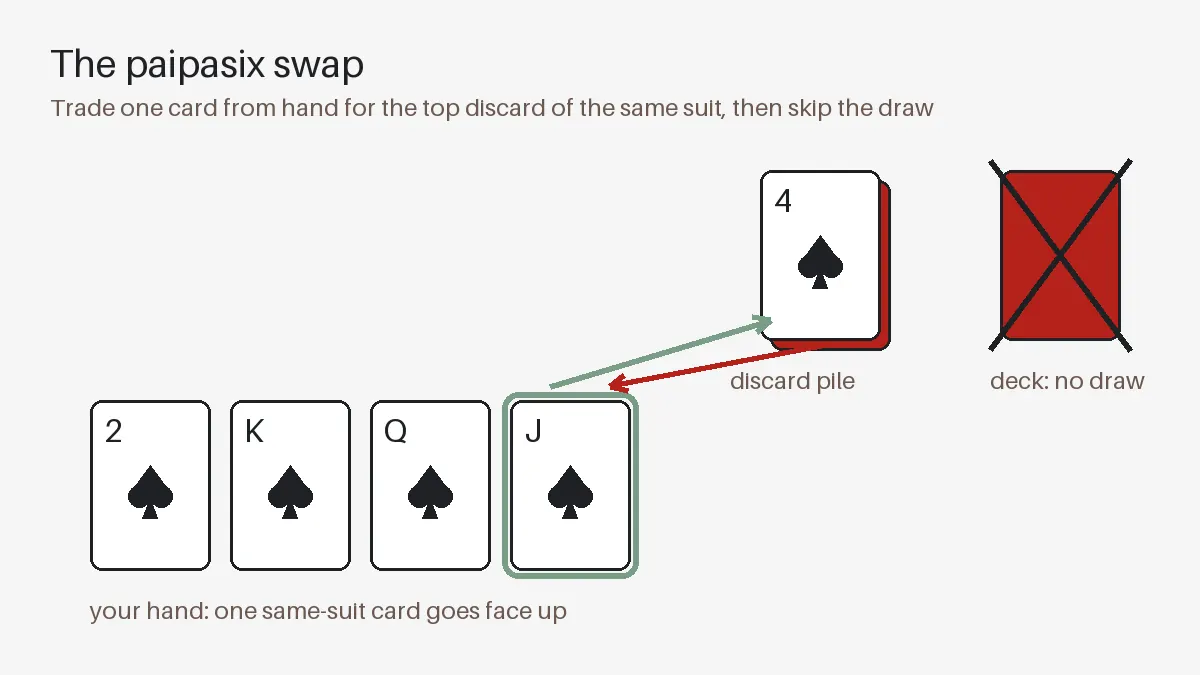
Paipasix is the name of a move in an invented card game that a few groups of friends play around the kitchen table. Both the game and the word are made up, so there is no official rulebook. What follows is the version most often described: a once-per-round swap that lets a player trade a card from hand with the face-up card on top of the discard pile.
The catch is that the two cards must share a suit, and a player who uses the swap gives up their normal draw for that turn. That cost keeps paipasix from being an automatic choice and turns it into a small decision that comes up again and again during play.
When the Move Is Allowed
A player may call paipasix at the start of their turn, before drawing. They announce it out loud, lay the chosen card from their hand face up, and pick up the discard in its place. The card they set down becomes the new top of the discard pile, ready for the next player to see.
Each player gets one use per round. Once everyone has had a turn and the dealer passes the deck, the right to swap resets.
A Sample Turn
Picture a player holding a spade they cannot use alongside two spades that almost form a run. The top discard is the four of spades. They call paipasix, put their unwanted spade face up on the pile, and take the four, which slots neatly into the run. Because they swapped, they skip the draw and play passes to the left. The next player now sees the spade they gave away and must decide whether it helps them.
Common Rulings at the Table
Since the game has no fixed rules, groups settle disputes in their own ways. These rulings come up most often.
- If the discard pile is empty, the move cannot be used.
- A swap that breaks the suit requirement is undone, and the player loses their turn.
- Face cards count as their printed suit with no exceptions.
- A player cannot swap back the card they discarded on their previous turn.
- Calling the move silently does not count, because it must be announced.
Groups that play often tend to write their house version of paipasix on an index card and keep it with the deck, so new players learn the same rules.
Strategy Notes for New Players
The best moment for paipasix is usually when the discard offers exactly the card you need to finish a set. Giving up a draw is a real cost, so swapping for a merely decent card often leaves you worse off than drawing blind.
Watch what you put down, too. The card you surrender sits on top of the pile where the next player can see it, and in a close game it might be just what an opponent wanted. Experienced players sometimes hold off on paipasix until late in the round, when the deck is thin and every known card matters more. Others use it early to signal a bluff. Either way, the move adds a moment of tension that makes a simple game more interesting.