Ladodant: The Edge-First Opening Explained
Last updated
Ladodant is a term from an invented board game, the kind of homemade strategy game friends put together at a kitchen table. The game uses a hexagon-shaped board, two colors of stones, and a simple goal: connect your two opposite sides before your opponent connects theirs. Ladodant is the name players gave to one particular way of starting.
Most new players open in the middle, where every direction feels open. A ladodant does the opposite. The first player places three stones in a gentle bend close to their own edge, building a short, sturdy wall before reaching toward the center. It looks timid at first, but it sets up a strong foundation for the rest of the game.
The Basic Shape
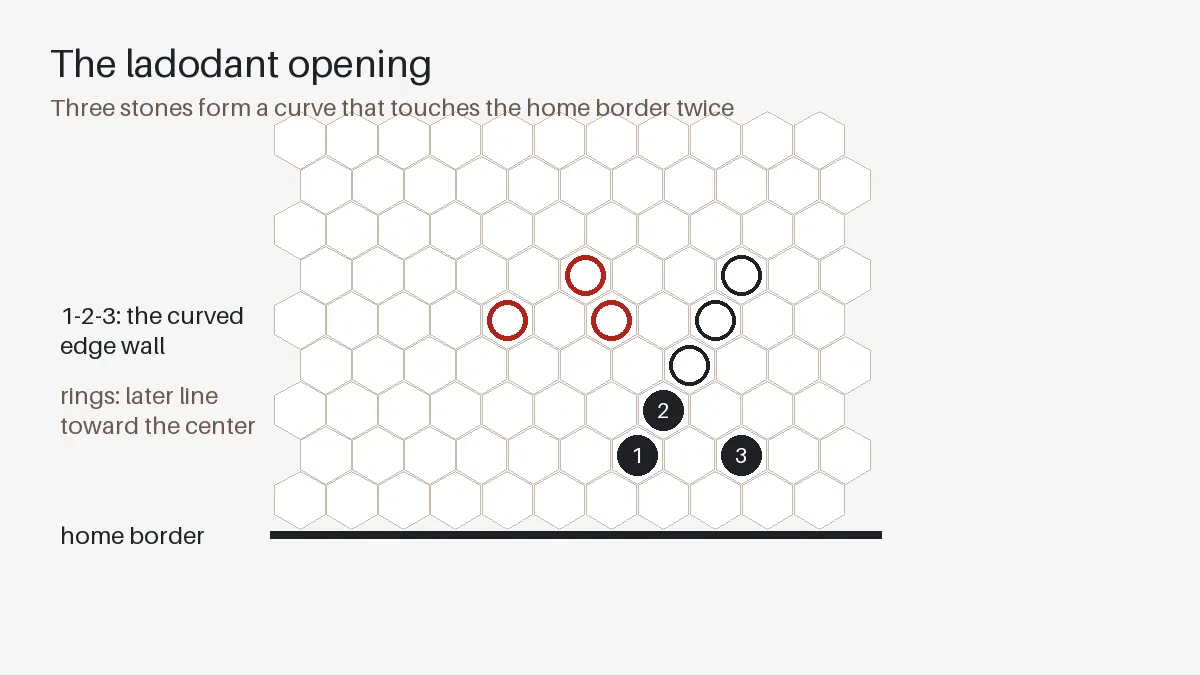
The opening starts with a stone two rows in from the home edge. The second stone goes diagonally beside it, and the third bends back toward the edge, forming a shallow hook. Together they create a wall that is very hard to cut through.
That hook is the heart of the whole idea. Because the stones touch the edge at two points, an opponent cannot slip between them and the border, which gives the opening player a safe anchor for later moves.
What Comes After the Hook
Once the hook is in place, the opening player usually spends the next few moves reaching outward from its tip in a straight line toward the center. The goal is not to win the middle outright but to link the safe anchor to whatever chain develops later. Each new stone stays connected, so the ladodant player rarely has to defend a loose group.
This slow build is why the ladodant suits players who like plans more than tactics. The opponent often gets more central territory early, yet has to work hard to stop a steady chain growing from a base that cannot be cut.
When the Ladodant Works Well
The opening shines in particular situations, so it helps to recognize them.
- Your opponent tends to rush the center and leave their own edge thin.
- The board is on the smaller side, where a strong anchor counts for more.
- You prefer patient, defensive games over fast trades.
- You are playing second in a round and need to blunt an early lead.
- Your opponent has not yet seen the hook and may misread it as weak.
On larger boards this start can feel slow, since the center has more room to develop. In those games some players delay the third stone and reach outward first, then return to finish the hook.
Answering a Ladodant
If you face a ladodant, resist the urge to attack the hook directly. It is designed to absorb that kind of pressure. A calmer reply is to claim the space just ahead of the wall, limiting how far the opening player can extend before the middle fills up.
Over time, groups that play this invented game tend to develop their own counters and variations. That is part of the fun of a made-up opening like the ladodant: there is no official book, so every table writes its own theory one game at a time.